Teks
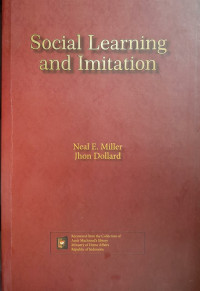
Social learning and imitation
by Neal E. Miller and John Dollard.
4 factors are essential to learning: drives, cues, responses, and rewards. Social motivations which are secondary drives include imitativeness, a process by which matched acts are evoked in two people and connected to appropriate cues. "In matched-dependent behavior, the leader is able to read the relevant environmental cue, but the follower is not; the latter must depend upon the leader for the signal as to what act is to be performed and where and when." In copying behavior "the copier must slowly bring his response to approximate that of a model and must know, when he has done so, that his act is an acceptable reproduction of the model act." The authors present not only a theoretical analysis of these problems but also experiments on rats and children where the problem has been to teach the subject to imitate. There is a discussion of crowd behavior, an analysis of a case of lynching, and a discussion of the diffusion of culture. Appendices present a revision of Holt's theory of imitation and a historical review of the general topic. "Our position is that if there are any innate connections between stimuli and responses of the initiative type, they are few and isolated." "In summary, imitation can greatly hasten the process of independent learning by enabling the subject to perform the first correct response sooner than he otherwise would… . In order for imitation to elicit the first correct response, the essential units of copying or matched-dependent behavior must already have been learned." (PsycINFO Database Record (c) 2016 APA, all rights reserved)
Availability
Detail Information
- Series Title
-
-
- Call Number
-
301.1 NEA s
- Publisher
- United States of America : Pub. for the Institute of human relations by Yale university press., 1941
- Collation
-
xiv, 341 hlm. illus., diagrs. 24 cm.
- Language
-
English
- ISBN/ISSN
-
-
- Classification
-
301.1
- Content Type
-
text
- Media Type
-
-
- Carrier Type
-
-
- Edition
-
First edition.
- Subject(s)
- Specific Detail Info
-
-
- Statement of Responsibility
-
Neal Elgar, John Dollard
Other version/related
No other version available
File Attachment
Comments
You must be logged in to post a comment
 Computer Science, Information & General Works
  Philosophy & Psychology
  Religion
  Social Sciences
  Language
  Pure Science
  Applied Sciences
  Art & Recreation
  Literature
  History & Geography