Teks
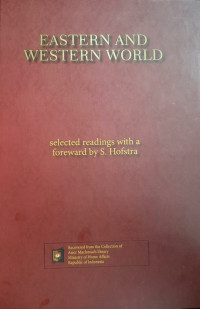
Eastern and Western World; selected readings
With a foreword by S. Hofstra. Under the auspices of the Netherlands Universities Foundation for International Co-operation.
THE SUMMER SESSIONS OF THE NETHERLANDS UNIVERSITIES INSTItuted since the war have attracted a good deal of attention among foreign students,
In 1951 and 1952 they were held at Leyden and dealt with the subject of the Eastern and Western World. In view of the interest shown in these lectures by those who attended them and of the importance of this subject, there seemed to be sufficient justification for their publication. A number of them have, therefore, been coz lected in the present volume.
The great significance of the subject need hardly to be stressed here. It can, of course, rightly be argued that the terms East and West may easily lead to misunderstanding, that they are liable to over-simplify e our thinking by posing a facile antithesis and also our notion of a reality, which, in all its economic, social and cultural variety, is far too complicated to be conveyed by two terms. Even if we agree, however, as to the difficulty of using such simple concepts as East and West, or whatever other terms we may preter to choose, the problem of the differences between cultures, between stages and aspects of development still remains. The growing unity of the world goes hand in hand with great contrasts in human conditions and values, and also between aspirations and their fulfilment. The impact of Western civilisation on other cultures, the social change to be witnessed everywhere, the upheaval caused by modern influences on hitherto relatively stable communities, the recent political movements and ideas, all these are creating problems whose nature and magnitude are both unprecedented.
Availability
Detail Information
- Series Title
-
-
- Call Number
-
303.4 HOF e
- Publisher
- The Hague, Bandung : W. van Hoeve., 1953
- Collation
-
181 hlm., 24 cm.
- Language
-
English
- ISBN/ISSN
-
-
- Classification
-
303.4
- Content Type
-
text
- Media Type
-
-
- Carrier Type
-
-
- Edition
-
Cet. 1
- Subject(s)
- Specific Detail Info
-
-
- Statement of Responsibility
-
S, Hofstra
Other version/related
No other version available
File Attachment
Comments
You must be logged in to post a comment
 Computer Science, Information & General Works
  Philosophy & Psychology
  Religion
  Social Sciences
  Language
  Pure Science
  Applied Sciences
  Art & Recreation
  Literature
  History & Geography