Teks
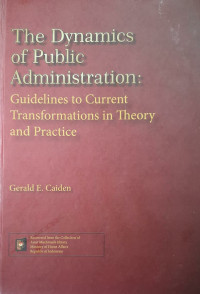
The Dynamics of Public Administration: guidelines to current transformations in theory and practice
[by] Gerald E. Caiden.
Go to any high location and look around. You probably will see many things that offend the senses—abandoned trash, aging property and unsightly buildings, neglected land, smog, traffic jams, polluted streams. Scan the headlines of any newspaper. You will find many more things to trouble you—wars, strikes, crime, riots, price rises and unemployment, international conflicts, natural disasters, technical mishaps.
' All these are matters of public importance, for they affect society as a whole, not only the immediate participants. Counteraction requires community, not individual, resolution and effective changes in direction depend on public intervention. To get something done, the collective (or societal, community, or public) will must be cultivated through complex institutional frameworks. This is the domain of public affairs—the reshaping of relationships between man and man and between man and nature. Public administration is that part of the public domain concerned with the administrative aspects of the resolution of public issues.
What constitutes the public domainpublic behavior, institutions and laws, as opposed to their private counterparts —varies in time and place, according to ideology, technology, political economy and administrative culture. Neither philosophers nor statisticians, or other technocrats—arguing from _ different conceptions, definitions, and idealshave been able to agree. Further, ideas change fairly quickly.
Availability
Detail Information
- Series Title
-
-
- Call Number
-
350 GER t
- Publisher
- New York : Holt, Rinehart and Winston., 1971
- Collation
-
x, 341 p. 24 cm.
- Language
-
English
- ISBN/ISSN
-
0030852323
- Classification
-
350
- Content Type
-
text
- Media Type
-
-
- Carrier Type
-
-
- Edition
-
-
- Subject(s)
- Specific Detail Info
-
-
- Statement of Responsibility
-
Gerald E Caiden,
Other version/related
No other version available
File Attachment
Comments
You must be logged in to post a comment
 Computer Science, Information & General Works
  Philosophy & Psychology
  Religion
  Social Sciences
  Language
  Pure Science
  Applied Sciences
  Art & Recreation
  Literature
  History & Geography